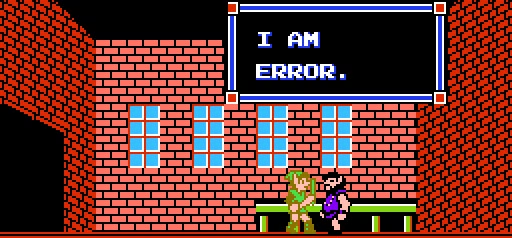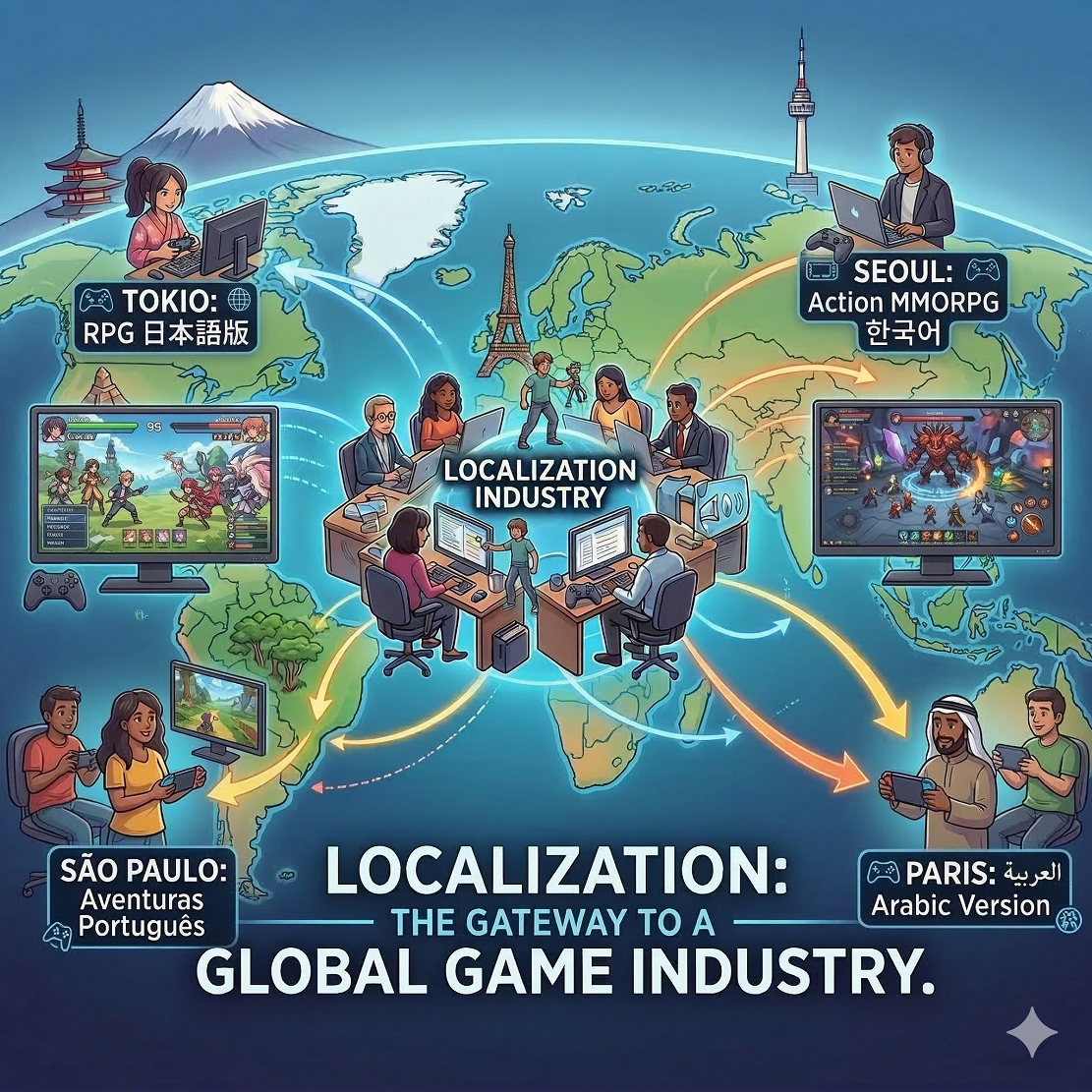


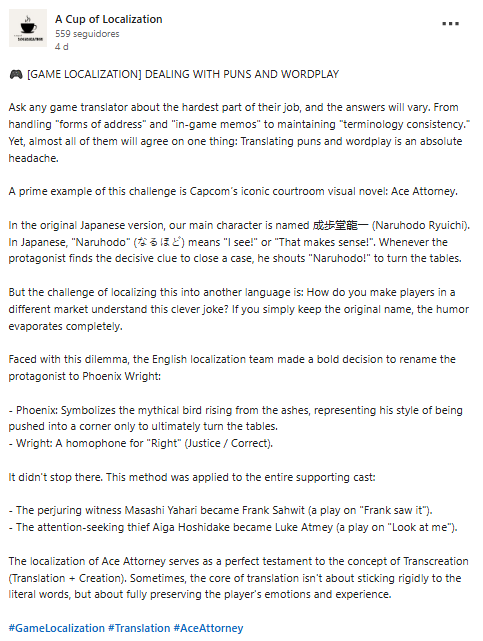
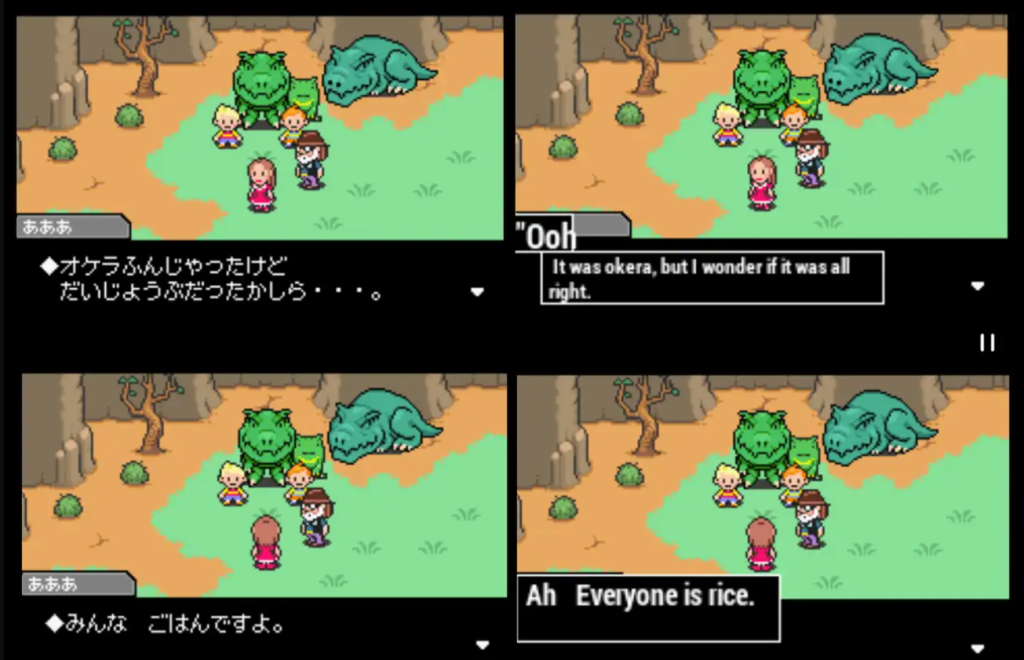
Anyone working with game localization knows this already: translation is rarely just about words. It’s about meaning, timing, cultural nuance, and sometimes… jokes that simply don’t survive the trip.
That LinkedIn post highlights a classic example from Ace Attorney. In the original Japanese version, the protagonist’s name carries a clever linguistic twist tied directly to the game’s logic and storytelling. It’s not just a name, it’s part of the narrative experience.
- The name reinforces key moments in gameplay
- It connects language with player discovery
- It adds a layer of satisfaction when things “click”
But here’s the problem: once you move that name into another language, the entire mechanism breaks.
A literal translation preserves the original form, but completely loses the meaning. And in a game built around deduction and revelation, that loss is significant.
Translation vs. Transcreation: where things get complicated
This is where localization becomes something much more complex than translation. We must guarantee the context match, not merely the translation per se.
The English version of Ace Attorney didn’t just translate the name, they reinvented it. “Phoenix Wright” wasn’t a direct equivalent, but it captured the spirit of the character and the themes of justice, resilience, and clever reasoning.
- “Phoenix” suggests rising from defeat
- “Wright” echoes “right” (as in justice or correctness)
- Together, they recreate the feeling of the original
This process is often called transcreation, a blend of translation and creative adaptation. But transcreation introduces a new layer of risk: inconsistency.
Once you move away from literal translation, every decision becomes subjective. And without structure, subjective decisions can quickly fragment across a project.
The scalability problem in creative localization
One clever rename is manageable. But what happens when you scale that across an entire game?
In the same example, supporting characters were also adapted with similar wordplay. Each name had to:
- Match the tone of the main character
- Preserve humor or linguistic intent
- Fit within the broader narrative world
Now imagine dozens, or hundreds of these decisions being made by multiple translators, editors, and reviewers.
Without coordination, you start to see problems:
- Different translators apply different styles of humor
- Naming conventions drift across chapters or updates
- Jokes lose coherence because they weren’t built from the same logic
What begins as a creative challenge quickly turns into an operational one.
.png)
Why glossaries are more than just terminology lists
This is where glossaries become critical, but not in the traditional sense. In game localization, glossaries are not just about defining terms like UI labels or item names. They act as a shared creative framework.
A well-structured glossary helps teams:
- Document naming conventions and tone guidelines
- Explain the reasoning behind creative choices
- Ensure that every contributor builds on the same foundation
For example, once “Phoenix Wright” is established, the glossary can clarify:
- Whether other names should follow similar wordplay
- What kind of humor is appropriate
- How literal vs. creative translations should be handled
Without this, every translator is essentially starting from scratch, and the result is inconsistency.
Consistency is what players actually feel
Players may not consciously notice localization decisions, but they absolutely feel inconsistency.
When tone shifts unexpectedly, or when jokes land differently across scenes, it breaks immersion.
- A serious moment followed by a mismatched joke
- A character name that feels out of place
- Dialogue that doesn’t align with previous interactions
These small fractures accumulate, and over time, they impact how players perceive the game as a whole. Consistency isn’t just a linguistic goal, it’s a user experience requirement.
Translation management systems: enabling alignment at scale
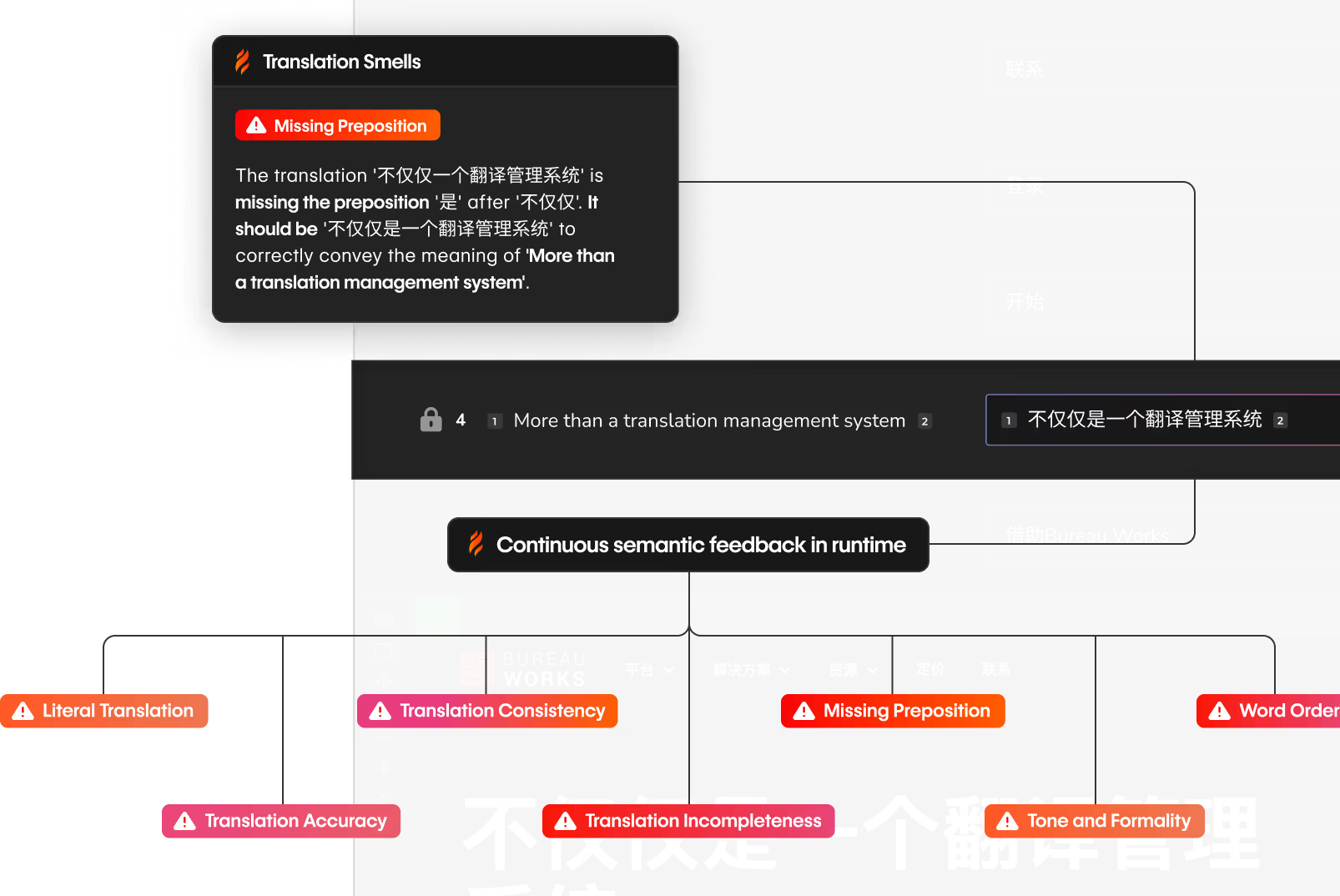
Managing all of this manually is not realistic, especially for modern game development cycles with frequent updates and multiple markets. This is where translation management systems (TMS) come into play.
A strong TMS acts as the operational backbone of localization:
- Centralized glossaries ensure everyone works from the same source of truth
- Translation memory helps maintain consistency across repeated structures
- Collaboration tools allow teams to discuss and refine creative decisions
Instead of isolated workstreams, teams operate within a connected system. This doesn’t limit creativity, it enables it to scale.
Because when translators have context, references, and alignment, they can focus on making better creative decisions, not reinventing the same ones repeatedly.
From isolated decisions to structured workflows
The real shift happens when localization moves from being reactive to structured.
Rather than solving problems one by one, teams can:
- Define guidelines early in the process
- Build reusable frameworks for tone and adaptation
- Maintain consistency even as projects evolve
This is especially important in live-service games, where new content is constantly being added. Without a system, every update risks introducing inconsistencies. With the right structure, new content naturally aligns with what already exists.
This is exactly the kind of challenge wxrks is designed to handle.
Instead of treating localization as a series of disconnected tasks, wxrks provides a centralized environment where creativity and consistency work together.
- Glossaries become living documents, not static files
- Teams stay aligned across languages, updates, and contributors
- Creative decisions are preserved and scaled, not lost over time
For projects involving wordplay, cultural nuance, and transcreation, this kind of structure is essential. It ensures that the experience you design is the experience players actually receive, no matter the language.
Ready to bring consistency to your localization process?
If your team is dealing with complex localization challenges, whether it’s wordplay, tone, or large-scale coordination, it might be time to rethink your workflow.
Sign up for wxrks and discover how a translation management system can help you preserve meaning, maintain consistency, and deliver better localized experiences at scale.
Unlock the power of glocalization with our Translation Management System.
Unlock the power of
with our Translation Management System.